
AI Didn’t Replace Judgment—It Raised the Standard for It
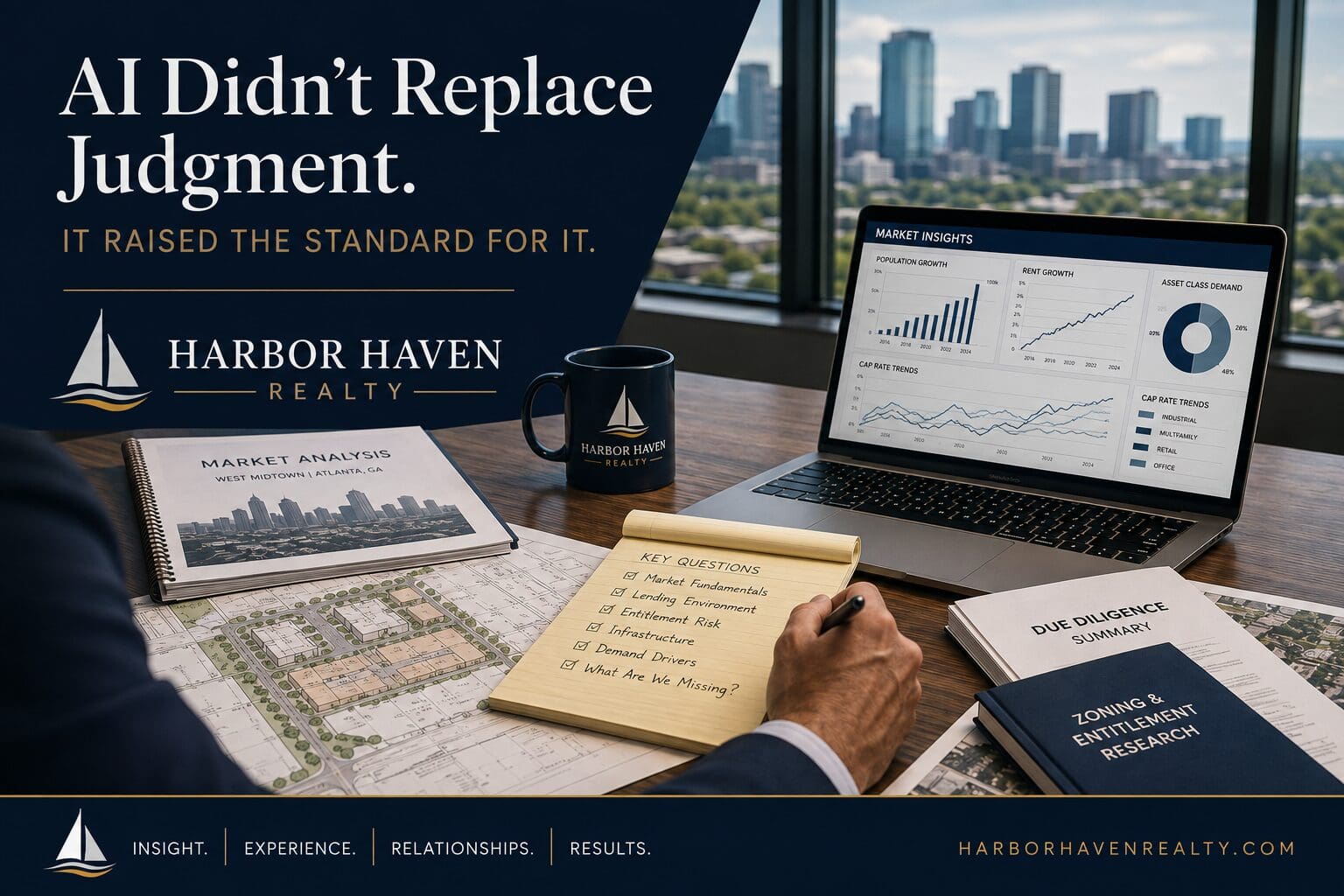
Why artificial intelligence is making experience, critical thinking, and independent judgment more valuable than ever in commercial real estate.
Published August 2026 | Investment Strategy
Artificial intelligence has quickly become one of the most discussed topics in commercial real estate. Nearly every week, someone asks whether AI will fundamentally change how brokers, investors, developers, lenders, and advisors make decisions.
The answer is yes—but perhaps not in the way many people expect.
Commercial real estate has always rewarded professionals who ask better questions, not simply those who find answers the fastest. AI is transforming how information is gathered, analyzed, and presented, but it is also changing what clients should expect from the professionals advising them.
After years of representing investors, financial institutions, developers, business owners, and commercial property owners, one lesson has remained consistent: the quality of a decision is rarely determined by the amount of information available. It is determined by asking the right questions, challenging assumptions, and understanding what may be missing from the analysis.
At Harbor Haven Realty, we use AI every day. It helps us organize research, summarize market reports, review lengthy documents, identify trends, compare investment opportunities, and spend more time advising clients instead of performing repetitive administrative tasks. Used correctly, it has become one of the most valuable tools available to commercial real estate professionals.
But AI is still just that—a tool.
The Difference Between Information and Judgment
One of the greatest risks isn’t that artificial intelligence will replace experienced advisors. The greater risk is that professionals begin accepting answers without challenging them.
Commercial real estate has always been an industry built on judgment.
Every appraisal represents an opinion of value. Every environmental report contains assumptions. Every market study reflects the information available at a specific point in time. Every broker opinion of value, underwriting model, feasibility study, demographic analysis, and lender recommendation requires interpretation.
Artificial intelligence should be viewed no differently.
AI often produces thoughtful, well-written, and remarkably confident responses. Yet confidence should never be mistaken for certainty. Information can be incomplete. Assumptions can be flawed. Critical context can be missing.
Experienced professionals understand that a polished answer isn’t necessarily the right answer.
The Questions That AI Can’t Ask
There’s another challenge that receives far less attention.
As AI systems learn how we communicate, they begin recognizing patterns in the questions we ask, the information we prioritize, and the types of responses we typically find helpful. That personalization makes AI more efficient—but it can also reinforce our own assumptions if we stop thinking critically.
In other words, AI doesn’t simply answer questions.
Over time, it begins answering questions the way it believes you want them answered.
That’s why experienced professionals don’t stop with the first response.
They challenge it.
The most valuable question is often the next one.
- What assumptions were made?
- What information is missing?
- What data contradicts this conclusion?
- What would someone with an opposing opinion say?
- What has changed since this information was published?
Those questions separate information from judgment.
Commercial Real Estate Requires More Than Data
Consider a development opportunity.
An AI platform may conclude that a property is well suited for multifamily development based on zoning, population growth, surrounding land uses, and demographic trends.
An experienced advisor immediately begins asking different questions.
- Is adequate sewer capacity available?
- How does today’s lending environment affect project feasibility?
- What does the local comprehensive plan indicate about future growth?
- Are infrastructure improvements planned?
- What political or entitlement challenges exist?
- Who owns the surrounding properties?
- What isn’t reflected in the available data?
Those questions rarely appear in a spreadsheet.
They come from years of evaluating transactions, understanding capital markets, interpreting economic trends, navigating entitlement processes, and recognizing that successful commercial real estate decisions require more than data alone.
Information supports decisions.
Experience tests information.
The combination produces better outcomes.
Technology Should Strengthen Professional Judgment
Technology has dramatically improved our ability to gather information.
It has not replaced the need to evaluate it.
At Harbor Haven Realty, we embrace AI because it allows us to spend less time collecting information and more time interpreting it. The real value isn’t in generating another report or another market summary. It’s in understanding what the information means, identifying what may be missing, and helping clients make better decisions with greater confidence.
The most effective commercial real estate professionals won’t be those who rely on AI the most.
They’ll be the ones who know when to challenge it.
Commercial real estate has never rewarded those who find answers the fastest.
It has always rewarded those who ask better questions than everyone else.
That principle isn’t changing.
If anything, AI is making it more important than ever.
About Harbor Haven Perspectives
Harbor Haven Perspectives is Harbor Haven Realty’s thought leadership series exploring commercial real estate investment, development, market trends, and advisory insights throughout Georgia and the Southeast.
Whether you’re evaluating your next acquisition, considering the sale of an asset, selecting a site for future development, or navigating today’s changing market conditions, we believe informed decisions begin with thoughtful analysis, disciplined research, and experienced guidance.